
There are many words I could use to describe my reaction to President Donald Trump’s immediate withdrawal from the 2015 Paris Agreement (again). I think the one that comes to mind strongest is devastated – and annoyed. Very annoyed.
But despite his best efforts to destroy all climate action in the United States, and overturn the work done by President Joe Biden over the last 4 years, all is not lost. I focus most of my work as a science communicator on positive news – all this depressing news (which is everywhere, constantly) just gets us, well, depressed. We need to find sources of positive news in all aspects of life, but for me, especially when it comes to news about the environment – positive nature news has been found to be a great solution to eco-anxiety!
So, in the name of tackling our collective eco-anxiety and trying to spin this distressing news on its head, I recently came across a wonderful bit of climate-optimistic news. Here’s what I found.
The Paris Agreement
Now, before we dive into the positive news, it’s important to understand just what the Paris Agreement is.
At COP21 (the Conference of the Parties on Climate Change) held in Paris in December 2015, 196 United Nations countries signed and adopted a new treaty, which came into force on 4th November 2016. The goal? To keep “the increase in the global average temperature to well below 2C above pre-industrial levels” and aim “to limit the temperature increase to 1.5C”.
Unfortunately, it seems we have surpassed the 1.5C aim, with 2024 being the first year in human history to breach this landmark temperature rise, thanks to the ongoing impacts of climate change, the burning of fossil fuels and biodiversity loss.
Yet despite this, countries across the globe are working on actions to tackle climate change and limit the temperature rise to 2C: the UK has set a legally-binding target to reach net zero by 2050, has phased out coal power and is focusing on increasing renewable energy resources, Sweden has built eco-quarters in its cities (old industrial sites converted into eco-friendly homes) and Brazil has focused on preserving and restoring the Amazon rainforest to mitigate rising emissions and protect the biodiversity within.

What does the US leaving mean for climate action?
One would be forgiven for thinking all is lost due to the USA’s withdrawal from the agreement, but this is not quite true.
Though the USA is a large player in global politics and has been at the forefront of the climate fight in recent years, it is not the only country that individuals, governments and organisations look to for positive climate action. As we covered briefly above, other countries such as Brazil, the UK and EU nations are taking steps to mitigate climate change, and scientists (and politicians) expect countries such as these, or even China to take the place of the USA in future climate talks.
As I mentioned before, though, there was some recent news that particularly caught my eye – that of the US Climate Alliance.
US Climate Alliance
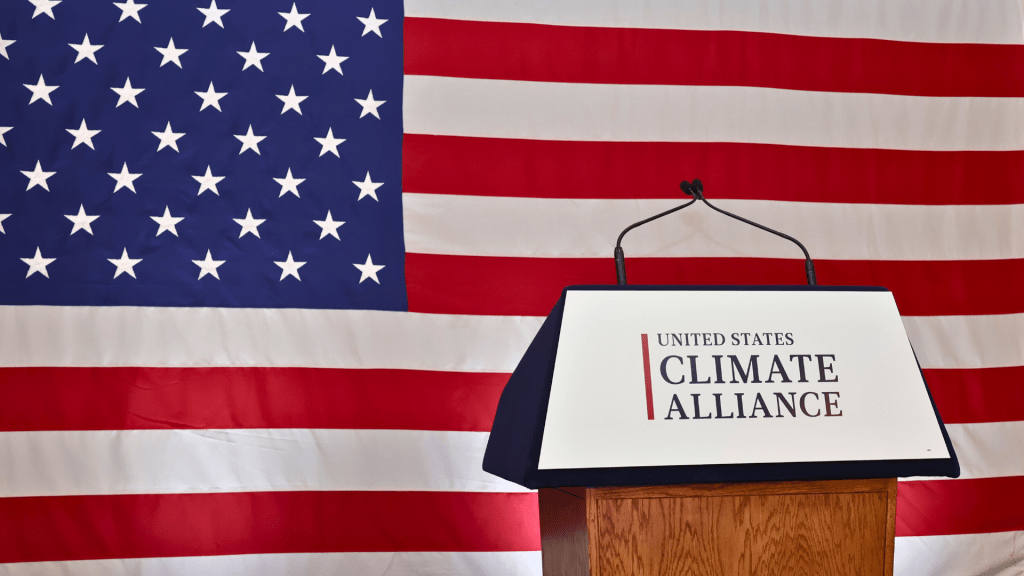
The Alliance, initially launched in 2017 when Trump previously pulled out of the Paris Agreement, is a coalition of 24 US Governors, co-chaired by the Governors of New York and New Mexico, but including states such as California, Colorado, Hawaii, New Jersy and even non-states Puerto Rico and Guam.
Back on 20th January 2025, the Alliance announced their aim of continuing America’s work to achieve the Paris Agreement’s goals, despite the lack of action from Washington DC.
In a letter to international leaders, the co-chairs noted that, due to the authority granted to governors by the US Constitution, they will advance and support impactful climate solutions, track and report on their progress to UN nations and even attend COP30 in Brazil later this year.
This is really hopeful news, not only due to the proof that there are those in the US Government who care for the environment but also based on their previous successes.
Between 2005 and 2022, the US Climate Alliance saw a collective greenhouse gas emission reduction of 19% and is now on track to meet its goal of reducing emissions by 26% by 2025. The coalition has also supported new jobs in the clean energy sector, ensuring employment in these areas is not only increased but made more accessible.
Back To The Start
As I said at the beginning, Trump’s immediate withdrawal from the world’s most important climate treaty is devastating news and fills me with much annoyance. None of that will go away, of course, but I feel it has been slightly lessened with the knowledge that there are people and politicians out there still fighting for our wonderful, fragile planet. I’m looking forward to seeing what they can get done in the next four years.
Sources:
Gunasiri et al. (2022) Int. J. Environ. Res. Public Health, 19 (9).
 George Edwards MSC
Leave a comment